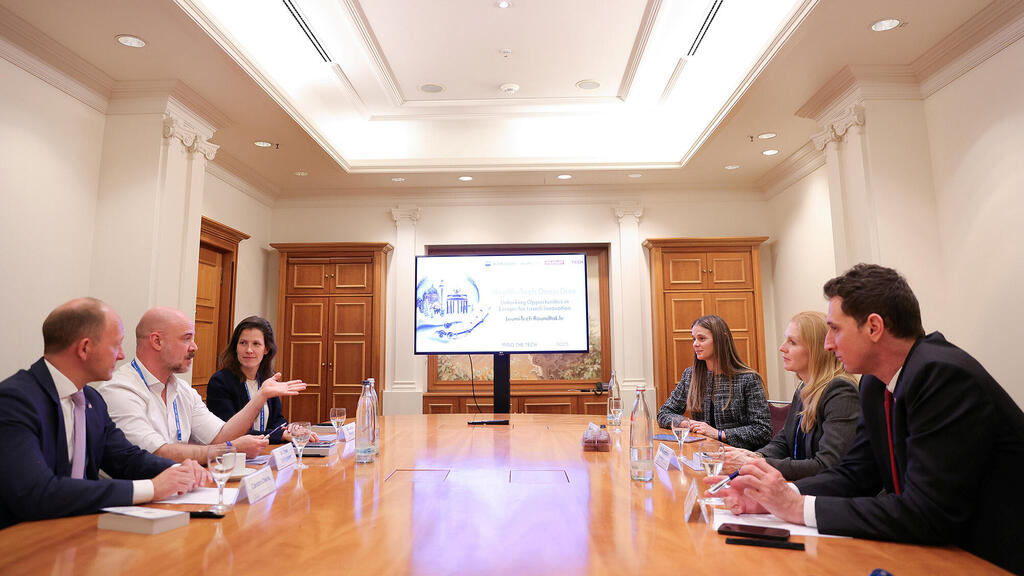
Mind the Tech Berlin 2025
"Hospitals, insurance companies and German investors want to work with Israeli companies"
Maya Eisen Zafrir, CEO of LeumiTech, was speaking during a roundtable discussion at the Mind the Tech Berlin 2025 conference. Dr. Carina Ruwolt, director at Bayer: "Every opportunity interests us." Dr. Florentine Kaniess of Charité University Hospital: "We are open to implementing technologies that will help us in the interface with the patient."


“We meet at a moment when health technologies (HealthTech) and artificial intelligence (AI) are moving from ‘innovation topics’ to essential infrastructures for the modern healthcare system,” said Maya Eisen Zafrir, CEO of LeumiTech, in a roundtable discussion at the Mind the Tech Berlin 2025 conference hosted by Calcalist and Bank Leumi. The discussion included Dr. Yoni Goldwasser, Managing Director, Springboard Health Angels Berlin; Carsten Ovens, CEO European Leadership Network - ELENT; Dr. Carina Ruwolt, Director Strategy Pharmaceutical at Bayer; Yaniv Tessel, Head of Economic and Trade Mission to Berlin, Foreign Trade Administration, Israeli Ministry of Economy and Industry; and Dr. Florentine Kaniess, Strategic Advisor to the CEO of Charité University Hospital.
According to Eisen Zafrir: “Across Europe, and especially in Germany, healthcare systems are under real pressure: an aging population, staff shortages, rising costs, and higher expectations from patients and clinicians. These pressures not only create challenges; they create a great opportunity for technology that can deliver better workflows, earlier interventions, personalized care, and significant improvements in efficiency. This is exactly where collaboration becomes powerful.
“Israeli healthcare high-tech brings speed, technological depth, and a culture of solving difficult problems. Germany brings scale, clinical rigor, and the ability to integrate solutions into structured and complex systems. When these strengths come together - when ingenuity and discipline work together - we see partnerships that go far beyond pilots and deliver real impact.”
“We are already seeing strong momentum,” she continued. “German corporations, hospitals, insurance companies, and investors are increasingly open to working with Israeli companies. Joint programs, missions, and initiatives are strengthening the bridge. There is a real desire on both sides: Israelis seeking a serious European entry point, and German partners seeking reliable innovation that solves operational and clinical pain points.
“The goal of today’s roundtable is to explore these opportunities more deeply, to develop insights and lessons entrepreneurs can use: where the real opportunities lie, what needs are most pressing, how to responsibly adopt AI, and what cultural or operational nuances are truly important when entering the German market. Together, I hope we can map the potential ahead and offer a clear picture of how Israeli and German strengths can combine to shape the next generation of healthcare technologies.”
Carsten Ovens agreed: “We are building bridges between Israel, Germany, and the rest of Europe in many areas.”
Dr. Yoni Goldwasser added: “I have founded several companies and recently formed a group of investors. We have invested in around 30 companies, focusing on special deals.”
Dr. Carina Ruwolt introduced herself: “I joined Bayer five years ago, and today I work extensively on AI initiatives.”
Dr. Florentine Kaniess: “I worked in venture capital before joining the hospital, and now I focus on accelerating innovation areas with the CEO. We collaborate a lot with Israeli companies.”
Yaniv Tessel: “We work extensively with companies in the healthcare sector.”
Eisen Zafrir: “We aim to accompany startups from the earliest stages throughout their lifecycle. We want to extract insights here for companies seeking to find their path.”
Ruwolt: “There is no field without a need for emerging technologies. Every opportunity interests us.”
Kaniess: “Our hospital has many needs, as we see in our collaboration with Sheba Medical Center, where technology is maximized. We are open to implementing technologies that improve patient interaction.”
Related articles:
Funding and Investment Opportunities
Goldwasser: “We are raising a new fund. We began in smart, accessible healthcare and moved into biopharma because the German market is very attractive, especially for companies with a long-term vision. Israeli companies need to understand that German culture prefers careful execution. Israelis embrace advanced technologies, while Germans prefer safe, proven solutions. Biopharma has a strong presence here and is a field that actively seeks innovation.”
Ovens: “There is significant regulation in Germany, but also huge potential for growth and analytics. We have a joint AI venture between Germany and Israel focused on automating and computerizing hospitals, which are currently under-digitized. They want to connect with the Israeli healthcare system to advance.”
Tessel: “Data that moves to the cloud also creates cybersecurity opportunities. We connect companies and entities; many cyber companies offer solutions to protect this data.”
Entering Large Organizations
Tessel: “Israeli companies should use our delegation in Berlin. There is strong demand, including in the dental sector. Sometimes, connecting with intermediary consultants costs money, and companies must be willing to invest. Experts can make the process smoother.”
Kaniess: “We have thousands of employees and cannot always identify the right contact for entrepreneurs. Companies need to clarify the challenge they are solving, whether it aligns with our priorities, and if it is high-impact. We want to adopt solutions that truly help.”
Bridges and Opportunities
Ovens: “Trade delegations and specialized associations exist, but companies must dedicate time and effort and not rush.”
Goldwasser: “In the past, we did not focus on Israeli companies, but that has changed. Early-stage companies face challenges raising funds. We now identify investments and connect them to local capital.”
Eisen Zafrir: “The early stages are the most challenging for startups. Germany offers opportunities not just for the U.S. market.”
Goldwasser: “We observe mistakes made in early stages in the U.S. and aim to help companies avoid them here.”
Eisen Zafrir: “In Germany, everything moves slower, but once a decision is made, execution begins. For many companies, Germany is the second market after the U.S.”
Ovens: “Germany is a gateway to Europe with favorable regulations compared to other countries.”
Ruwolt: “Many companies underestimate regulatory differences across European countries. Starting in Germany is significant and advantageous.”
Goldwasser: “Success in Germany often translates globally. Many focus solely on the U.S., but Germany offers a strong alternative.”
Why Startups Should Consider Germany
Tessel: “The public health system here is strong and increasingly open to innovative companies. There is a huge need, and funding is available.”
Kaniess: “A window of opportunity exists, and the political system allows initiatives to happen. In 2027, a significant opportunity will open in healthcare. Startups must adapt to the timing and the needs of the market.”


