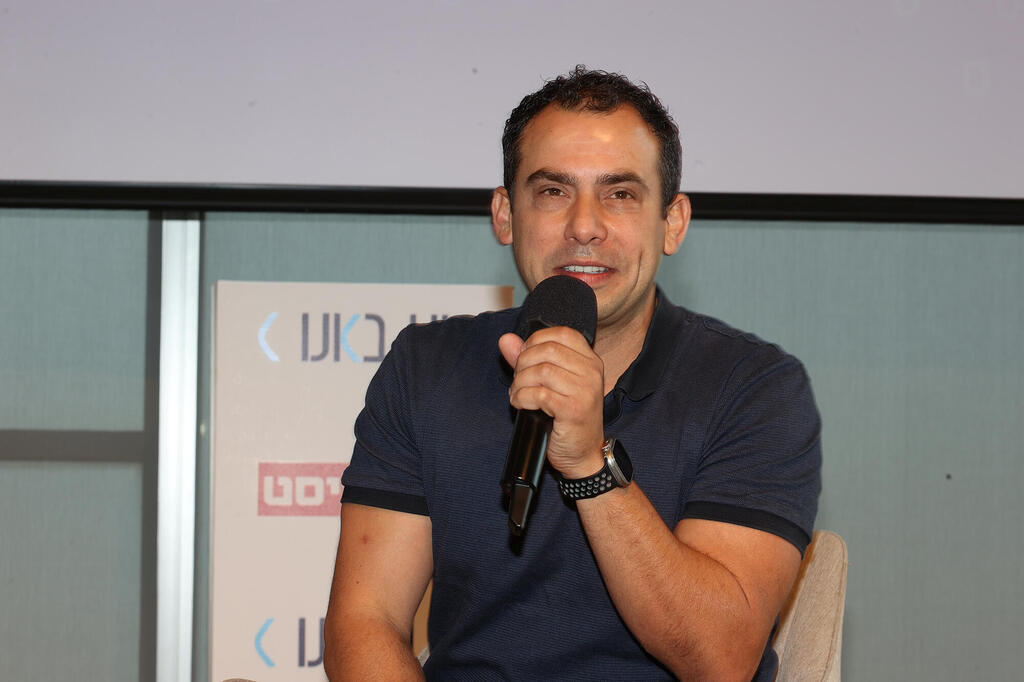
Nvidia SVP: “Networking accounted for over $7B last quarter - more than the entire Mellanox deal”
Amit Krig, Nvidia’s Senior Vice President for Networking Software and head of Nvidia Israel, says the company’s networking business now surpasses the value of its $7B Mellanox acquisition, underscoring Israel’s central role in the company’s AI infrastructure strategy.


By any measure, Nvidia’s Israeli operations have become the company’s nerve center outside the United States. What began as a foothold with the 2020 acquisition of Mellanox has turned into the semiconductor giant’s most important foreign base.
“We have over 5,000 employees today and have recruited about a thousand engineers in the past year alone,” said Amit Krig, Nvidia’s Senior Vice President for Networking Software and head of Nvidia Israel. “We’re continuing at the same pace.”
That pace reflects Nvidia’s global expansion and the growing strategic weight of Israel in the company’s operations. With sites stretching from Tel Hai in the north to Be’er Sheva in the south, Krig said the company is now 120% over capacity in Be’er Sheva and tripling its space to attract young engineers in the region.
Israel, he noted, is Nvidia’s largest center outside the U.S., surpassing India and China. “If you look at it in terms of contribution, everything is based on the Mellanox acquisition,” he said. “All the networking for the world’s supercomputers, hundreds of thousands of GPUs that need to communicate, runs through what we do here.”
That contribution is now visible in Nvidia’s bottom line. The company’s networking division generated over $7 billion in the second quarter of 2025, nearly double last year’s figure, and greater than the total Mellanox acquisition price five years ago.
“The networking part was over seven billion this quarter,” Krig said. “Already more than what the entire Mellanox deal was worth.”
But Krig also sounded a warning about the sustainability of Israel’s high-tech leadership.
“There aren’t enough engineers,” he said. “For us to keep developing at this pace, there needs to be a supportive environment, an ecosystem around us. High-tech feeds itself, but not forever. We need to constantly think about how we drive this engine and what innovation we’re creating around Israeli tech.”
He said universities and the tech industry need to rethink how they select and train engineering students to meet the demands of the AI era. “The change is so big that we need to rethink everything, who comes to study, how we sort them,” he said. “I hope we make changes faster than other countries so we can continue to lead.”
The company’s growth comes amid a period of recovery in Israel following the Gaza war, which halted visits from senior executives for nearly two years.
“Now we have delegations coming every week,” Krig said. “We’re hosting them, showing how much we’ve developed during these two years.”
Related articles:
He confirmed Nvidia remains committed to building a major new campus in northern Israel, a move that could eventually take local employment into the five figures. “We’re continuing at a very high pace,” he said. “If we keep going like this, we’ll very quickly reach 10,000 people.”
Krig also mentioned the return of Avinatan Or, an Nvidia engineer who was held hostage in Gaza for over two years, as well as the death of another employee in the conflict. “It’s been very emotional,” he said. “But we’re also looking ahead.”
For Krig, who joined Mellanox as its 40th employee and was among its first software engineers, Israel’s challenge now mirrors Nvidia’s own: sustaining success in a field where technology, and competition, move faster than ever.
“It’s very, very difficult to be first place and stay first place,” he said. “We need to walk around with that same anxiety about Israeli high-tech, to keep thinking how we can innovate so that we can truly say there’s still high-tech here for many years to come.”


